 Add to Chrome
 Add to Firefox
 Add to Edge
SANTS: A State-Adaptive Scheduler for World Action Models
May 27, 2026
World Action Models (WAMs) improve robot manipulation by using video-based future representations to condition action generation. In pixel-space WAMs, however, the best action condition is not necessarily the fully denoised video. Controlled denoising-depth scans show that video refinement can reduce action error up to a state-dependent point, after which the gain may saturate or even reverse when late predictions become less action-relevant or physically unreliable. This suggests that action generation should use a state-dependent point along the video noise trajectory rather than a fixed terminal denoising depth. We introduce State-Adaptive Noise Trajectory Scheduler (SANTS), a lightweight scheduler for video-to-action diffusion policies. At each video decision point, SANTS reads the current video-state representation and noise level, then jointly predicts a cumulative stopping hazard and a relative noise-progression ratio. SANTS is post-trained with a path-level reward computed after the frozen action branch generates the final action chunk, so the scheduler is optimized for downstream action quality rather than intermediate video fidelity, while redundant video-state updates are explicitly penalized. Experiments show that SANTS reaches \(94.4\%\) overall success on RoboTwin 2.0 and \(73.1\%\) average success across seven real-robot tasks, while reducing latency by \(81.7\%\) and \(79.0\%\) relative to full video denoising, respectively. These results indicate that adaptive selection along the video noise trajectory can preserve the control benefits of WAM-style future reasoning while removing much of its redundant inference cost.

Learning A Unified Risk Map for Autonomous Driving in Partially Observable Environments
May 21, 2026Occlusion-aware prediction remains a critical challenge in autonomous driving due to the inherent uncertainty of unobserved regions. Existing approaches either overestimate risk based on reachable states or struggle to predict accurate trajectories under high occlusion uncertainty. To address these limitations, we propose a unified risk map modeling and learning framework for partially observable environments. Our method integrates traffic flow risk and collision risk through spatiotemporal modeling, enabling fine-grained assessment of occlusion-induced hazards. To address the scarcity of scenarios involving occluded interactions, we introduce a diffusion-based scenario generation framework that produces realistic yet adversarial scenarios. We integrate the modeling and learning of a unified risk map into a framework that supports risk-aware planning under partial observability. Experiments on the Waymo Open Motion Dataset show that our method significantly outperforms the state-of-the-art occlusion-aware baseline, improving minimum time-to-collision by 0.78 times and average time-to-collision by 1.67 times. The proposed framework offers a comprehensive and practical solution for risk-aware planning in partially observable environments.
Unveiling the Surprising Efficacy of Navigation Understanding in End-to-End Autonomous Driving
Apr 14, 2026Global navigation information and local scene understanding are two crucial components of autonomous driving systems. However, our experimental results indicate that many end-to-end autonomous driving systems tend to over-rely on local scene understanding while failing to utilize global navigation information. These systems exhibit weak correlation between their planning capabilities and navigation input, and struggle to perform navigation-following in complex scenarios. To overcome this limitation, we propose the Sequential Navigation Guidance (SNG) framework, an efficient representation of global navigation information based on real-world navigation patterns. The SNG encompasses both navigation paths for constraining long-term trajectories and turn-by-turn (TBT) information for real-time decision-making logic. We constructed the SNG-QA dataset, a visual question answering (VQA) dataset based on SNG that aligns global and local planning. Additionally, we introduce an efficient model SNG-VLA that fuses local planning with global planning. The SNG-VLA achieves state-of-the-art performance through precise navigation information modeling without requiring auxiliary loss functions from perception tasks. Project page: SNG-VLA
CMoE: Contrastive Mixture of Experts for Motion Control and Terrain Adaptation of Humanoid Robots
Mar 03, 2026For effective deployment in real-world environments, humanoid robots must autonomously navigate a diverse range of complex terrains with abrupt transitions. While the Vanilla mixture of experts (MoE) framework is theoretically capable of modeling diverse terrain features, in practice, the gating network exhibits nearly uniform expert activations across different terrains, weakening the expert specialization and limiting the model's expressive power. To address this limitation, we introduce CMoE, a novel single-stage reinforcement learning framework that integrates contrastive learning to refine expert activation distributions. By imposing contrastive constraints, CMoE maximizes the consistency of expert activations within the same terrain while minimizing their similarity across different terrains, thereby encouraging experts to specialize in distinct terrain types. We validated our approach on the Unitree G1 humanoid robot through a series of challenging experiments. Results demonstrate that CMoE enables the robot to traverse continuous steps up to 20 cm high and gaps up to 80 cm wide, while achieving robust and natural gait across diverse mixed terrains, surpassing the limits of existing methods. To support further research and foster community development, we release our code publicly.
Tri-Subspaces Disentanglement for Multimodal Sentiment Analysis
Feb 23, 2026Multimodal Sentiment Analysis (MSA) integrates language, visual, and acoustic modalities to infer human sentiment. Most existing methods either focus on globally shared representations or modality-specific features, while overlooking signals that are shared only by certain modality pairs. This limits the expressiveness and discriminative power of multimodal representations. To address this limitation, we propose a Tri-Subspace Disentanglement (TSD) framework that explicitly factorizes features into three complementary subspaces: a common subspace capturing global consistency, submodally-shared subspaces modeling pairwise cross-modal synergies, and private subspaces preserving modality-specific cues. To keep these subspaces pure and independent, we introduce a decoupling supervisor together with structured regularization losses. We further design a Subspace-Aware Cross-Attention (SACA) fusion module that adaptively models and integrates information from the three subspaces to obtain richer and more robust representations. Experiments on CMU-MOSI and CMU-MOSEI demonstrate that TSD achieves state-of-the-art performance across all key metrics, reaching 0.691 MAE on CMU-MOSI and 54.9% ACC-7 on CMU-MOSEI, and also transfers well to multimodal intent recognition tasks. Ablation studies confirm that tri-subspace disentanglement and SACA jointly enhance the modeling of multi-granular cross-modal sentiment cues.
CLCR: Cross-Level Semantic Collaborative Representation for Multimodal Learning
Feb 23, 2026Multimodal learning aims to capture both shared and private information from multiple modalities. However, existing methods that project all modalities into a single latent space for fusion often overlook the asynchronous, multi-level semantic structure of multimodal data. This oversight induces semantic misalignment and error propagation, thereby degrading representation quality. To address this issue, we propose Cross-Level Co-Representation (CLCR), which explicitly organizes each modality's features into a three-level semantic hierarchy and specifies level-wise constraints for cross-modal interactions. First, a semantic hierarchy encoder aligns shallow, mid, and deep features across modalities, establishing a common basis for interaction. And then, at each level, an Intra-Level Co-Exchange Domain (IntraCED) factorizes features into shared and private subspaces and restricts cross-modal attention to the shared subspace via a learnable token budget. This design ensures that only shared semantics are exchanged and prevents leakage from private channels. To integrate information across levels, the Inter-Level Co-Aggregation Domain (InterCAD) synchronizes semantic scales using learned anchors, selectively fuses the shared representations, and gates private cues to form a compact task representation. We further introduce regularization terms to enforce separation of shared and private features and to minimize cross-level interference. Experiments on six benchmarks spanning emotion recognition, event localization, sentiment analysis, and action recognition show that CLCR achieves strong performance and generalizes well across tasks.
Temporal-Spatial Decouple before Act: Disentangled Representation Learning for Multimodal Sentiment Analysis
Jan 20, 2026Multimodal Sentiment Analysis integrates Linguistic, Visual, and Acoustic. Mainstream approaches based on modality-invariant and modality-specific factorization or on complex fusion still rely on spatiotemporal mixed modeling. This ignores spatiotemporal heterogeneity, leading to spatiotemporal information asymmetry and thus limited performance. Hence, we propose TSDA, Temporal-Spatial Decouple before Act, which explicitly decouples each modality into temporal dynamics and spatial structural context before any interaction. For every modality, a temporal encoder and a spatial encoder project signals into separate temporal and spatial body. Factor-Consistent Cross-Modal Alignment then aligns temporal features only with their temporal counterparts across modalities, and spatial features only with their spatial counterparts. Factor specific supervision and decorrelation regularization reduce cross factor leakage while preserving complementarity. A Gated Recouple module subsequently recouples the aligned streams for task. Extensive experiments show that TSDA outperforms baselines. Ablation analysis studies confirm the necessity and interpretability of the design.
Pheromone-Focused Ant Colony Optimization algorithm for path planning
Jan 12, 2026Ant Colony Optimization (ACO) is a prominent swarm intelligence algorithm extensively applied to path planning. However, traditional ACO methods often exhibit shortcomings, such as blind search behavior and slow convergence within complex environments. To address these challenges, this paper proposes the Pheromone-Focused Ant Colony Optimization (PFACO) algorithm, which introduces three key strategies to enhance the problem-solving ability of the ant colony. First, the initial pheromone distribution is concentrated in more promising regions based on the Euclidean distances of nodes to the start and end points, balancing the trade-off between exploration and exploitation. Second, promising solutions are reinforced during colony iterations to intensify pheromone deposition along high-quality paths, accelerating convergence while maintaining solution diversity. Third, a forward-looking mechanism is implemented to penalize redundant path turns, promoting smoother and more efficient solutions. These strategies collectively produce the focused pheromones to guide the ant colony's search, which enhances the global optimization capabilities of the PFACO algorithm, significantly improving convergence speed and solution quality across diverse optimization problems. The experimental results demonstrate that PFACO consistently outperforms comparative ACO algorithms in terms of convergence speed and solution quality.
Resolving State Ambiguity in Robot Manipulation via Adaptive Working Memory Recoding
Dec 31, 2025State ambiguity is common in robotic manipulation. Identical observations may correspond to multiple valid behavior trajectories. The visuomotor policy must correctly extract the appropriate types and levels of information from the history to identify the current task phase. However, naively extending the history window is computationally expensive and may cause severe overfitting. Inspired by the continuous nature of human reasoning and the recoding of working memory, we introduce PAM, a novel visuomotor Policy equipped with Adaptive working Memory. With minimal additional training cost in a two-stage manner, PAM supports a 300-frame history window while maintaining high inference speed. Specifically, a hierarchical frame feature extractor yields two distinct representations for motion primitives and temporal disambiguation. For compact representation, a context router with range-specific queries is employed to produce compact context features across multiple history lengths. And an auxiliary objective of reconstructing historical information is introduced to ensure that the context router acts as an effective bottleneck. We meticulously design 7 tasks and verify that PAM can handle multiple scenarios of state ambiguity simultaneously. With a history window of approximately 10 seconds, PAM still supports stable training and maintains inference speeds above 20Hz. Project website: https://tinda24.github.io/pam/
LMPOcc: 3D Semantic Occupancy Prediction Utilizing Long-Term Memory Prior from Historical Traversals
Apr 18, 2025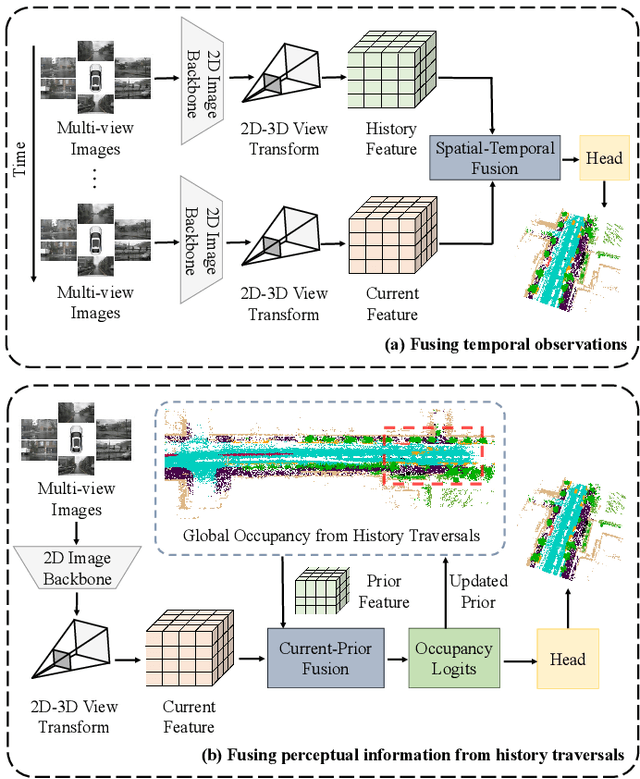
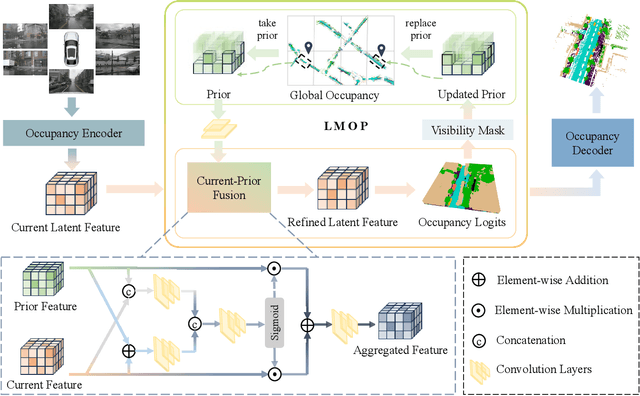
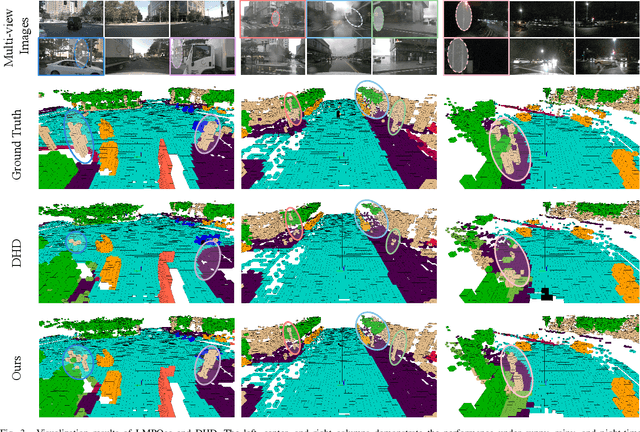
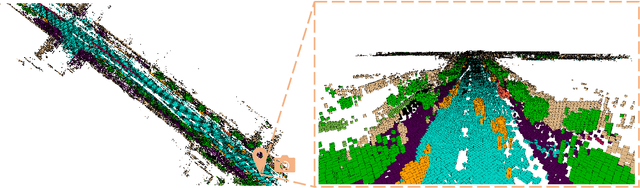
Vision-based 3D semantic occupancy prediction is critical for autonomous driving, enabling unified modeling of static infrastructure and dynamic agents. In practice, autonomous vehicles may repeatedly traverse identical geographic locations under varying environmental conditions, such as weather fluctuations and illumination changes. Existing methods in 3D occupancy prediction predominantly integrate adjacent temporal contexts. However, these works neglect to leverage perceptual information, which is acquired from historical traversals of identical geographic locations. In this paper, we propose Longterm Memory Prior Occupancy (LMPOcc), the first 3D occupancy prediction methodology that exploits long-term memory priors derived from historical traversal perceptual outputs. We introduce a plug-and-play architecture that integrates long-term memory priors to enhance local perception while simultaneously constructing global occupancy representations. To adaptively aggregate prior features and current features, we develop an efficient lightweight Current-Prior Fusion module. Moreover, we propose a model-agnostic prior format to ensure compatibility across diverse occupancy prediction baselines. LMPOcc achieves state-of-the-art performance validated on the Occ3D-nuScenes benchmark, especially on static semantic categories. Additionally, experimental results demonstrate LMPOcc's ability to construct global occupancy through multi-vehicle crowdsourcing.